ABSTRACT:
This research project surveys forty-nine parents of children that are students at the UCLA University Village child services/preschool who are between the ages of two to five years of age. Their children’s media usage is further investigated and findings show that out of all the media available to children for educational purposes in this age bracket, parents allow their children to engage in books 73.5% of the time as opposed to all other forms of media. Television comes in second at 57.1%. Even though more than half of our participants believe that video games as a learning tool does not equate to violent aggression and social disorders, parents are still hesitant to use video games more as an educational tool. The reason for this hesitancy is because of the lack of substantive evidence of new media forms such as the computer or video games. In conclusion, children at this age need to be constantly supervised by their parents to reap benefits instead of negative behaviors from the plethora of digital/ traditional educational media that are available for consumers today. It is not the actual medium (either television, books or video games) that could lead to detrimental effects in a young child but more so the actual content a young child is exposed to, therefore content supervision is vital. The participants used for the survey are also from a higher educational level since most are either parents that work or study at the University of California in Los Angeles, so that factor may explain their particular views when it comes to their child’s media usage, particularly video gaming as an educational tool.
This paper addresses concerns of parents that have children between the ages of three to five years old and their children’s’ media usage, with a specific interest in video
games as an educational tool of as opposed to other forms of media available in the market for young children.
Children are being exposed to our rapidly evolving digital technologies at a much younger age today than ever before. With the variety that parents have to choose for their young off-springs, it can be overwhelming and confusing as a consumer. Parents, those in particular who want to actively participate in teaching their young children how to build important learning skills such as reading ,math and arts have recently been turning to video games as an educational tool. There are many different forms of media a parent can use to help educate their children, by combining digital and traditional technologies to foster a varied approach to learning. A branch of science that closely relates to this research study is child psychology, a branch of psychology that studies the social and mental development of children. This project specifically looks at pre-school/ kindergarten age children because this is around the time where children start reading, writing their name, doing basic math skills and a time when kids really begin to play out their incredibly creative imagination. Since there is a critical “educational” developmental window during this age, it is important to look at all of the media options that are available in the market for parents to help their children foster a desire for learning. We shall look at the various forms of media as an educational tool, how often children at this age are being exposed to them by parents who send their children to the UCLA University Village School and the general consensus of parents on allowing their young child to play videogames as opposed to other media options for learning.
Children at this age need to be constantly supervised by their parents to reap maximum benefits from the plethora of digital/ traditional educational media that are available for consumers today. The three predictions foreseen are the following:
1. Parents such as myself are somewhat still reluctant to introduce other forms of educational tools that they were not raised with, such as video games and computer use over television or watching dvd’s.
2. We also predict that out of all the forms of media available for preschoolers today, it is still the traditional print era of books that parents are more comfortable using as an educational tool as opposed to the computer or video game.
3. And lastly, parents will allow their child to watch television out of all media options available. Educational television shows such as Sesame Street is an examples of a show parents allow for viewing most often.
However, what parents need to understand is that this passive and sedentary form of entertainment of watching television albeit the educational shows available such as Sesame Street and the like still pale in comparison to the benefits of “playing” educational videogames and computer games. Supervision and moderation are the keys to combating the fear of parents to these new digital mediums.
Hypothesis
I test my hypothesis by conducting a survey of seventeen questions. I analyze the data collected from my survey of fourty-eight (48) parents of young children between the ages of two to five years old( 2-5 ), which are students at the UCLA University Village childcare facilities located on Sepulveda Boulevard in Los Angeles, California. The survey questions parents on the various forms of media such as television, online computer games( which is categorized as a video game), video games on traditional gaming consoles, educational DVD’s such as the LeapFrog Series, music from cd’s and radio and the least popular form of media among parents- films in the traditional movie theatre.
The various forms of entertainment available to children today have many educational benefits from what parents presume. This is how parents justify this new media form of play as opposed to traditional “outside time” or playground play in the sanbox. Three reasons that parents have been restricting their children to play outside are the growing fears of an unsafe world as rampantly depicted in the news, no access to parks, paygrounds or backyards because of either location or living situation ( apartments as opposed to houses with backyards) and lastly, because parents are continuously multitasking and merely exhausted to venture outside and would rather stay indoors, their children included.
Existing Research Available on Young Children’s Media Usage
There is existing research available today about preschool children and their new media use. A national survey entitled: “Age, Ethnicity, and Socioeconomic
Patterns in Early Computer Use” claim that at the as early as 2 1/2 years of age, children are introduced to computer use by being placed on a caregivers/ parents lap and by the age of 3 ½,children are usually allowed to autonomously use a computer on their own, with parental supervision. This survey specifically addresses the effects of early computer use on young children and dispels a report published by the American Academy of Pediatrics which recommended limiting exposure to “screen time” (television and Computer use). Socio- economics of families were also investigated and families from a higher income bracket were obviously more than likely to own a computer or have access to the internet. The findings indicate that no relationship was found between the frequency with which children play computer games and the likelihood that they can read, but increased non- game computer use was associated with increased likelihood of reading (STROUSE, 2005).
In another survey, children under eleven and their media usage (television, computer and video games) were investigated. Their findings indicate that a combined video and computer game usage exceeded television usage. Both children of low- and high-income parents are at risk for certain behaviors associated with television usage and parents whose children watched more television were more likely to be concerned about the amount of television their child watched (DIMITRI A. CHRISTAKIS, 2004).
A report published for the Henry Kaiser Family Foundation in the Fall of 2003 had some overwhelming statistical data that reinforces how media usage among young children continue to have unknown effects which requires more investigative and scientific research. From a national survey the institution conducted by collecting data from 1,000 parents of 6 month to 6 year olds, their findings indicate the following: Children six and younger spent an average of at least two hours a day in front of a screen, either television or video. Television also is introduced early on before the medical community recommends. Fifty percent (50%) of children from the ages of four to five years of age have already been exposed to video games and seventy percent (70%) have used a computer. This clearly indicates that young children are using new digital media much younger than expected. Two out of three children are in an environment where the television is left on without anyone watching and one third of the time a television is on around the clock, or all the time. These children in these environments also read less than their counterparts that shut the television off when noone is watching. Parents justify their childs exposure to media because they see media as an important education tool. Lastly, television watching has direct effects on their child’s behavior, where positive attitudes are copied more frequently than negative attitudes.(Rideout, Vandewater, & Wartella, 2003).
Another interpretive study of children’s social interactions was held in a family child care setting, where children were seen to spend a significant portion of their time playing, watching others play, and distracted by video games. When children were focused on video games, their interactions with another child were disjointed and rushed. Because children’s interactions are considered to be important learning opportunities, the prevalence of video games in child care settings and the implications of their use should be studied more closely (Bacigalupa, 2005).
The lack of examination on the value of computer use for play purposes has led to a research study published in 2003 which analyzed the different theoretical approaches of play and their developmental value on a child’s psychology. By examining the ways in which video game play contributes to a child’s development in the early stages of childhood, caregivers and educators can make an informed decision on what particular software children can benefit from. A next step in this study claims the need to further investigate the criteria of computer software designed for young children as a guideline for designing developmentally appropriate games (Irina Verenikina, 2003).
Methods:
I test my hypothesis by conducting a survey via php ESP that analyses the data collected from forty-nine (49) parents of young children between the ages of two to five years old( 2-5 ), which are students at the UCLA University Village childcare facilities located on Sepulveda Boulevard in Los Angeles, California. The following data was collected:
1. Age of their child
2. What kind of media do their children engage in most frequently/ least.
3. How many hours a day do they let their children watch television, play on the computer or video games.
4. What kind of Video Games they have let their child play in the past with options of various video games for the young child market.
5. If parents believed that children who play video games are more prone to violent behaviors and social disorders and their explanations for such beliefs.
6.If parents believed there were any benefits to children playing video games.
7. If there were any people beside their child who played video games in their home and what kind.
8. How their child reacts when they are told to stop playing video games.
9. If the parents themselves have do play or have played video games in the past and what kind.
10. And finally, what effects parents think video games have on their child's psychology.
Complications that have arisen during data collection that were unexpected was how the executive director of the child care services at the University village school asked me if I had an IRB for this research project. An Institutional Review Board is a committee that has been formally designated to approve, monitor, and review biomedical and behavioral research involving humans with the aim to protect the rights and welfare of the research subjects according to Wikepidia. Because of that slight confusion that I needed to have one in place for my survey, I was not able to get my survey out to parents sooner than I anticipated. Other than that little confusion, parents were very willing to participate in my project and share their thoughts on how they feel about their child's video game and media usage. Another complication that needs to be addressed is the distinction between playing on the computer as opposed to playing a video game. For the purposes of this survey, playing an online game on a website such as PBS, Nick Jr. and Disney is considered a videogame. This will be explained in more length in the discussion portion of this paper.
The participants used for the survey are also from a higher educational level since most are either parents that work or study at the University of California in Los Angeles, so that factor may explain their particular views when it comes to their child’s media usage, particularly video gaming as an educational tool. A future study correlating socio- economic factors with a young child’s media usage might have very different results as the ones presented in this paper.
Results and Discussion:
Fig 1
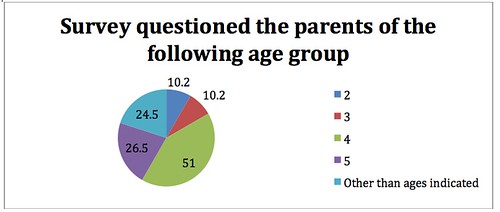
Fifty one percent (51%) of the parents surveyed currently have children in the four year old age group followed by parents of five year old children.
Fig 2
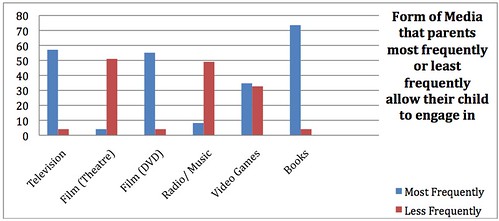
The figure 2 graph above indicate that parents allow their children to engage in books 73.5% of the time as opposed to all other forms of media. Television comes in second at 57.1%. The least frequent form of media that children in this young demographic are exposed to are films in the theatre with a percentage of 51% followed closely by the radio/music in 49%.
Fig 3
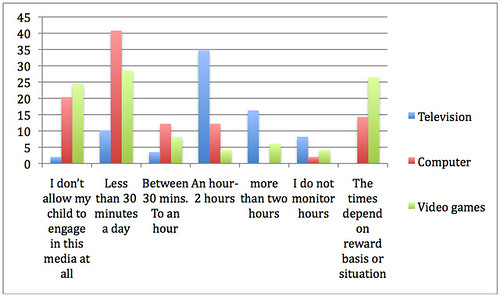
The Figure 3 graph above indicates the hours they allow their children to engage in the three most popular forms media. 34.7 %, which is seventeen (17) out of fourty-nine (49) parents allow their child watch between thirty (30) minutes to an hour a day. Surprisingly, none of these parents let their child watch TV as an incentive program for a reward for good behavior. Only four(4) out of fourty-nine (49) parents, which makes up 8.2 % do not monitor their child’s TV hours. Computer play is much more regulated than television for young children, according to our surveyed parents. 40.8% of parents only allow less than thirty (30) minutes of play a day, with only one(1) parent not monitoring their child’s computer play hours at all. Interestingly, 14.3% of parents use an incentive program to play on the computer. When it comes to video games however, 26.5 % of parents use video games as a reward for good behavior followed by 28.6% of parents that limit video game play to less than 30 minutes a day. Finally, there is still resistance of parents to allow their child at this early age to play video games at all since 24.5% of parents do not allow their child to play video games yet.
Fig 4
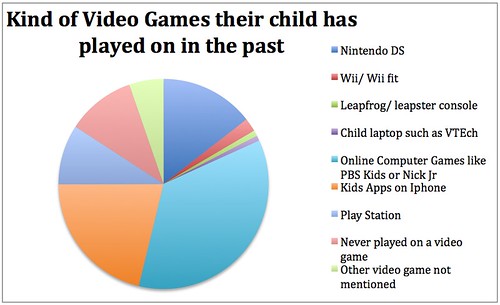
For the purposes of this study a clear distinction must be made if playing on the computer can be defined as playing a video game. Since the computer games that these children engage in at this early age are mostly online websites mentioned in the above graph, I argue that they indeed can be categorized as a video game because the keypad of the computer replicates buttons found on the consoles of various video game controllers. It is also important to recognize that these online videogames such as PBS, Nick Jr. and Disney are supplemented by television conglomerates to extend their brand online as an educational tool for young children. Another factor to consider but is an entirely different paper all together is that these websites have advertising on the website as opposed to their television cartoon versions.
From what we can see in Figure 4, Video games that are available from online websites are played on a home computer 55.1% as compared to other forms of video games. This may be due to the fact that most people today own home computers and the cost of playing does not require a parent to purchase a separate console specifically to play video games on. The Wii/ Wii fit is the next video gaming console that a young child has played on in the past besides online computer games and this reasoning is being justified by parents because it requires active participation, which in turn motivates a parent to allow more usage as opposed to the other options of video games available for young children that are physically more sedentary.
A big percentage of parents (95.9%) believe that there are many benefits to playing video games. The table below are some excerpts from the survey conducted on why parents believe video games are beneficial for their young children:
Computer technologies
Practicing writing letters/numbers on a machine vs. Paper.
Games enhance creativity- makes them learn how to strategize , to think and use their minds.
Video games are interactive, build on motor skills and cognitive skills.
Development of hand- eye coordination, gross & fine motor skills, defining spatial relationships, strategizing and thinking ahead and developing knowledge of historical or events on the subject of the game.
Children can exercise now while playing video games, it can also stimulate your brain- hand coordination.
Brain exercise
Video games are now complex and requires a lot of critical thinking and logic.
Help to develop math or word spelling ability.
Only 8 out of 49 parents, 16 % claim that no one else in the household plays video games but the 85 % of parents say that either an older sibling, parent or one of their cousins play videogames in their household. Parents however give their children a time limit on how long they can play and when a child is asked to stop playing video games, mostly all children comply, with only a small number asking for an extension of not more than five more minutes to play. Interestingly, only a handful of parents have played video games in the past and if they did, they are mush different from the educational options available for children in this generation. The parents that have played are mostly arcade games or first generation games on a home console such as Pacman, Space invaders, Tetris, Donkey Kong and Super Mario.
Conclusion:
Fig. 5
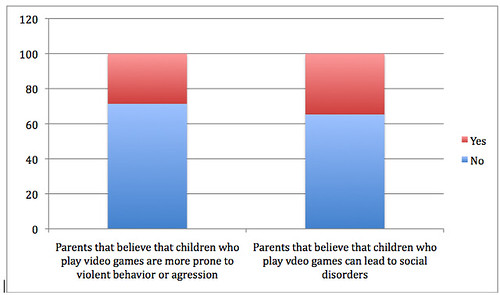
Findings show that there are still parents that think video game play can have negative benefits to a child such as aggressive behavior (28.6%)s and social disorders (34.7%). The consensus of parents suggest that parental supervision is required especially at this early age and because it really depends on what video game a child plays as opposed to the mere exposure to any sort of video game that could prove to be detrimental in the future. More parents understand the importance of guiding their children and monitoring which games they play. It is not the form of media that effects the behavior of a child as much as the content of the media the child is exposed to. A study done in 1987 claims that violent video games arouse children in much the same way as violent television cartoons and can have detrimental effects on a child’s behavior (Steven B. Silvern, 1987) and parents today still agree with these findings. . An overwhelming 95.9 % of parents believe that video games are beneficial to young children. Video Games when monitored and supervised are like other mediums such as television where it is not the medium that could lead to negative behavior but the content of what a medium reinforces. My prediction that books out of all media forms still rank as the #1 educational tool that parents feel most comfortable is substantiated by the survey conducted. Our hypothesis is supported by the surveys finding that parents need to be active participants in their children’s media usage because it is the content and not the form of media that could possibly lead to aggressive and social disorders in the future.
Works Cited
Bacigalupa, C. (2005). The Use of Video Games by Kindergartners in a Family Child Care Setting. Early Childhood Education Journal , 33 (1), 25-30.
DIMITRI A. CHRISTAKIS, M. M. (2004). TELEVISION, VIDEO, AND COMPUTER GAME USAGE IN CHILDREN UNDER 11 YEARS OF AGE. Child Health Institue, Department of Pediatrics, . Seattle: University of Washington.
Irina Verenikina, P. H. (2003). Child’s Play: Computer Games, Theories of Play and Children’s Development. IFIP Working Group 3.5 Conference: Young Children and Learning Technologies, Theoretical Perspectives (p. 8). Paramata: Australian Computer Soceity, Inc.
Rideout, V. J., Vandewater, E. A., & Wartella, E. A. (2003). Zero to Six: Electronic MEdia in the Lives of Infants, Toddlers and Preschoolers. Henry Kaiser Family Foundation, Menlo Park.
STROUSE, J. L. (2005, January). Age, Ethnicity, and Socioeconomic Patterns in Early Computer Use . American Behavioral Scientist , 590-607.
.
Showing posts with label UCLA. Show all posts
Showing posts with label UCLA. Show all posts
Thursday, June 3, 2010


Monday, May 24, 2010
The future of Journalism amidst the evolving media era
The digital/electronic era is upon us and is very rapidly killing the traditional print era of information. “New Media”, specifically the internet is the primary reason why the newspaper industry is on a sharp decline. More people are subscribing less to the traditional form of the news via physical newspapers and instead are getting their news online either via the internet or their mobile/ digital applications . Currently, ordinary citizens are using the digital technologies to connect on a global platform and are contributing their own ideas, voices and information thereby participating in an “online” society. The ability to generate your own information/ news and share it with the rest of the world is presently at a click of a mouse and even the mere definition of journalism and its components are itself evolving. This paper specifically addresses the shift of journalism from the print era to new era of digital media and theoretically comes to the resolution that instead of fearing what the future has in store for the dissemination of news in the “new media” landscape, we must embrace this new form of journalism, which involves the collaboration of society as a “participatory culture” and “global village”.
Through out history, access to news and information was a privilege for only a certain demographic who had access to wealth and power. The print era shifted that exclusion of information because of the ability to provide affordable mass-produced quantities of news and information to all sectors of society. This era however also creates a “sense of distance between reader and writer, electronic technologies, through their speed and audiovisual form, bring us together. Yet as opposed to face to face communication, the electronic media keep us apart (Strate, 2008)”. The audience that seeks out news today have become more fragmented because of the birth of the internet. They must thereby develop new ways to discern factual and legitimate news sources from other less reliable sources online as opposed to the traditional routine of a cup of coffee with the morning paper , where fact checking was never part of the process because of the legitimacy and reputation that a news publication held. A new form of journalism has now been defined because of the advent of online news sources.
Journalists used to be heralded as the “gatekeepers” of news that solely possessed the power on what topics the public should discuss and argue about which is dubbed as the agenda setting- theory. However, this system is now being challenged not only by the technology on how news is shared and transmitted to an audience via digital sources but the actual audience themselves. Through “web blogging” the audience themselves have a way to participate in what news gets written and disseminated. Blogging are personal publishing systems where a user generates their own content on a website. Because of the inexpensive cost to publish a “blog”, an explosion of websites from topics ranging from one’s personal College dorm life experience to how to make delectable cakes are all available for the public to peruse. “Blogs are in some ways a new form of journalism, open to anyone who can establish and maintain a Web site, and they have exploded in the past year,” writes Walter Mossberg, technology columnist for the Wall Street Journal (Shayne Bowman, 2003).
There are several theoretical perspectives that can explain why the traditional newspaper is declining. Media ecologists, such as Marshal McLuhan theorize that the medium itself needs to be inspected closely rather than the actual content that is generated. In journalism, the media environment is the world wide web where people acquire their news from a “global village” or a collection of sources. We are all interconnected to each other because of the technologies we use. McLuhan came up with the theory of a “global village” in the 1960’s and it has taken over several decades before we are able to fully recognize what he was theorizing about. There is no denying that McLuhans’ “global village” is synonymous to what we presently know as the internet! Thus, McLuhan’s global village analogy can be directly aligned with the perspective of new journalism because news and information is now pulled from several sources . A theory that is much similar is Jenkin’s “participatory culture” which has fully emerged because of the advent of new media. Jenkins’ idea of a participatory culture is when a grass roots movement of people are equal and active in society contribute to a particular issue versus information that is fed to the public or controlled by the top down systems such as media conglomerations. Jenkin’s also introduces the “Principle of Collective intelligence” which is exactly what the internet has now evolved into, a digital space where one can disclose what they think and share their views to a “global” online audience. This collective sharing of information also pertains the ethics of information where people share what they know about the world around them thus contributing to the greater good of society because of the wealth of information available to everyone. Since the motivations of the newspaper conglomerations in the print era are driven by economics to make a profit, it can not rely on subscriptions alone. Newspapers need to sell ad space to advertisers on the actual physical copy. Because the primary motivation of newspapers are to make a profit, the ethics of information and diversity are restricted and regulated.
There are several ways an online news source fulfills the function of a printed paper besides the economic profits that mainly drive newspaper conglomerations. New media is changing the very concept of what news is because online, the audience defines what is news worthy through the thoughts and comments they generate through forums and blogs. News has become more personalized and people only search for news items that they are generally interested in. As mentioned above, journalism traditionally filtered out content and had it was the editors that possessed the power to pick what was news worthy. Online, it’s a much different story as bloggers do not have editors silencing their opinions on a matter. There is more of a personal connection because people can respond to a news item via blogging in a forum and the author has the capability to enter into discussions with the audience. The only human connection on the printed paper was to write a letter to the editor. There was no guarantee of an interactive discussion since the printed paper has space restrictions. If a news item or letter to an editor didn’t make the cut on the printed paper, it was lost into oblivion. There are no space restrictions online which makes for a media environment with more dialogue between reader and author.
However there is much criticism for online news sources on how it fails to fulfill the function of the printed paper. Because of the abundance of websites that hold differing view on one single news topic, cross referencing facts by “cross- clicking” is a necessity. Being able to discern bloggers that try to remain as unbiased as possible can be a difficult task. Readers must therefore pull on several reliable online trade papers that have online versions before taking a bloggers view on a particular issue at hand. The question of much debate is if bloggers are even “journalists” to begin with, who are writing with a thorough and unbiased objectivity for the truth or are they mere pundits on the web? Traditional journalists have editors to review their reports as opposed to bloggers whose facts are checked by the audience after the fact that it has been disseminated by their post. Bloggers are able to quickly post a story unlike the traditional “ journalists” who have editors, yet their news item may contain facts which are seemingly questionable.
A disclaimer for “CNN I Report” claims the following: “”I Report is a user-generated section of CNN.com. The stories in this section are not edited, fact-checked or screened before they are posted” (http://www.ireport.com/). I go to this website because people from around the world can essentially be a journalists reporting news that is local in their area as it happens. The CNN website has a reliable system of verifying the stories that people submit by simply placing a label on the video content that are generated by it’s users. A label that states “Not vetted by CNN” mean that the story has not been checked or cleared by a CNN online editor. A red logo with CNN I Report in the left hand corner of a video means that the video has been verified by a CNN producer. What transpires on the site are a collection of “normal people” who choose what is news worthy and as an audience I am able to view stories that are interesting to me, thus making my news viewing more personalized. Anyone can sign up for their own account and share any stories that are of interest to them. There is also a discussion link where people can debate on the current “hot topic” of the day. The best Ireports that get “vetted” also have a chance to make it to any of the CNN platforms such as their television news channel.
The crisis that is facing the newspaper industry and changes in new media technology are interconnected because the reader now has the capacity to be more interactive than ever before. Let us not fear the unknown and instead embrace these shifts in media eras by giving the audience the tools to have their opinions and thoughts heard.
Through out history, access to news and information was a privilege for only a certain demographic who had access to wealth and power. The print era shifted that exclusion of information because of the ability to provide affordable mass-produced quantities of news and information to all sectors of society. This era however also creates a “sense of distance between reader and writer, electronic technologies, through their speed and audiovisual form, bring us together. Yet as opposed to face to face communication, the electronic media keep us apart (Strate, 2008)”. The audience that seeks out news today have become more fragmented because of the birth of the internet. They must thereby develop new ways to discern factual and legitimate news sources from other less reliable sources online as opposed to the traditional routine of a cup of coffee with the morning paper , where fact checking was never part of the process because of the legitimacy and reputation that a news publication held. A new form of journalism has now been defined because of the advent of online news sources.
Journalists used to be heralded as the “gatekeepers” of news that solely possessed the power on what topics the public should discuss and argue about which is dubbed as the agenda setting- theory. However, this system is now being challenged not only by the technology on how news is shared and transmitted to an audience via digital sources but the actual audience themselves. Through “web blogging” the audience themselves have a way to participate in what news gets written and disseminated. Blogging are personal publishing systems where a user generates their own content on a website. Because of the inexpensive cost to publish a “blog”, an explosion of websites from topics ranging from one’s personal College dorm life experience to how to make delectable cakes are all available for the public to peruse. “Blogs are in some ways a new form of journalism, open to anyone who can establish and maintain a Web site, and they have exploded in the past year,” writes Walter Mossberg, technology columnist for the Wall Street Journal (Shayne Bowman, 2003).
There are several theoretical perspectives that can explain why the traditional newspaper is declining. Media ecologists, such as Marshal McLuhan theorize that the medium itself needs to be inspected closely rather than the actual content that is generated. In journalism, the media environment is the world wide web where people acquire their news from a “global village” or a collection of sources. We are all interconnected to each other because of the technologies we use. McLuhan came up with the theory of a “global village” in the 1960’s and it has taken over several decades before we are able to fully recognize what he was theorizing about. There is no denying that McLuhans’ “global village” is synonymous to what we presently know as the internet! Thus, McLuhan’s global village analogy can be directly aligned with the perspective of new journalism because news and information is now pulled from several sources . A theory that is much similar is Jenkin’s “participatory culture” which has fully emerged because of the advent of new media. Jenkins’ idea of a participatory culture is when a grass roots movement of people are equal and active in society contribute to a particular issue versus information that is fed to the public or controlled by the top down systems such as media conglomerations. Jenkin’s also introduces the “Principle of Collective intelligence” which is exactly what the internet has now evolved into, a digital space where one can disclose what they think and share their views to a “global” online audience. This collective sharing of information also pertains the ethics of information where people share what they know about the world around them thus contributing to the greater good of society because of the wealth of information available to everyone. Since the motivations of the newspaper conglomerations in the print era are driven by economics to make a profit, it can not rely on subscriptions alone. Newspapers need to sell ad space to advertisers on the actual physical copy. Because the primary motivation of newspapers are to make a profit, the ethics of information and diversity are restricted and regulated.
There are several ways an online news source fulfills the function of a printed paper besides the economic profits that mainly drive newspaper conglomerations. New media is changing the very concept of what news is because online, the audience defines what is news worthy through the thoughts and comments they generate through forums and blogs. News has become more personalized and people only search for news items that they are generally interested in. As mentioned above, journalism traditionally filtered out content and had it was the editors that possessed the power to pick what was news worthy. Online, it’s a much different story as bloggers do not have editors silencing their opinions on a matter. There is more of a personal connection because people can respond to a news item via blogging in a forum and the author has the capability to enter into discussions with the audience. The only human connection on the printed paper was to write a letter to the editor. There was no guarantee of an interactive discussion since the printed paper has space restrictions. If a news item or letter to an editor didn’t make the cut on the printed paper, it was lost into oblivion. There are no space restrictions online which makes for a media environment with more dialogue between reader and author.
However there is much criticism for online news sources on how it fails to fulfill the function of the printed paper. Because of the abundance of websites that hold differing view on one single news topic, cross referencing facts by “cross- clicking” is a necessity. Being able to discern bloggers that try to remain as unbiased as possible can be a difficult task. Readers must therefore pull on several reliable online trade papers that have online versions before taking a bloggers view on a particular issue at hand. The question of much debate is if bloggers are even “journalists” to begin with, who are writing with a thorough and unbiased objectivity for the truth or are they mere pundits on the web? Traditional journalists have editors to review their reports as opposed to bloggers whose facts are checked by the audience after the fact that it has been disseminated by their post. Bloggers are able to quickly post a story unlike the traditional “ journalists” who have editors, yet their news item may contain facts which are seemingly questionable.
A disclaimer for “CNN I Report” claims the following: “”I Report is a user-generated section of CNN.com. The stories in this section are not edited, fact-checked or screened before they are posted” (http://www.ireport.com/). I go to this website because people from around the world can essentially be a journalists reporting news that is local in their area as it happens. The CNN website has a reliable system of verifying the stories that people submit by simply placing a label on the video content that are generated by it’s users. A label that states “Not vetted by CNN” mean that the story has not been checked or cleared by a CNN online editor. A red logo with CNN I Report in the left hand corner of a video means that the video has been verified by a CNN producer. What transpires on the site are a collection of “normal people” who choose what is news worthy and as an audience I am able to view stories that are interesting to me, thus making my news viewing more personalized. Anyone can sign up for their own account and share any stories that are of interest to them. There is also a discussion link where people can debate on the current “hot topic” of the day. The best Ireports that get “vetted” also have a chance to make it to any of the CNN platforms such as their television news channel.
The crisis that is facing the newspaper industry and changes in new media technology are interconnected because the reader now has the capacity to be more interactive than ever before. Let us not fear the unknown and instead embrace these shifts in media eras by giving the audience the tools to have their opinions and thoughts heard.
Wednesday, April 14, 2010
What is your life story in 350 words or less!
For a Gaming Mind Communication Studies Assignment at UCLA-the students were given this prompt:
For Thursday, please contemplate what are the stories that organize your life today.
These are narratives that specify your long-term goals in life, and may say something about why these particular goals are worth achieving. Often the goals are implausibly good outcomes -- not in the sense that they are unrealistic, but in the sense that they can be achieved only if you make a concerted and sustained effort.
The narratives will also contain information about the known or likely obstacles and costs you can expect to have to incur to reach your goals.
The stories also contain information about the resources you think of yourself as having to meet and overcome the obstacles. These resources may be your intellect, your personality, your parent's wealth, your good looks, your intrinsic genious -- find out what you are thinking and write it down!
Finally, the stories may contain the outline of your strategic thinking on how your resources can be marshalled into effective actions to overcome your obstacles and achieve the goal.
Write about 350 words on this topic as a response to this entry, and reflect on how aware you were of the underlying story of your life.
I wanted to share with you my life story. What's yours?
Growing up, I was shuttled around by my single mom to three different continents on a yearly basis. It seemed that when I was younger, all I wanted was a "normal" life, where I could stay in one school for more than a year and make friends I could keep for the rest of my life. But the sad reality was that my mother, being a single mom had to go where her work led her, which included uprooting me where ever she went. As I hit my teen years, the years of instability led me to rebel and think I could act like a grownup and abide by my own rules. By the time I turned 16, I quit high school in New Jersey, was living on my own in Manila and started supporting myself as a model and actress. There were a few years were the only goal I had was to be able to support myself financially. My goals became monetarily rooted. When I passed the hurdle of financial woes shortly after starting my acting career, My goals once again shifted to become more career oriented. I worked hard hoping that before my current gig ended I would already be casted in the next project. When that goal was reached on a consecutive basis which seemingly made me quite bored and ungrateful, my goals were more inclined towards training myself through acting technique and study. Unabashedly, I gave up a lucrative career in the Philippines to move to New York to study at the Lee Strasberg Theatre Institute in Manhattan. After school, I moved to California and continued to audition for various projects. Then love came knocking on my door and I married the man of my dreams. Two children later, I realize once again my goals have evolved. To raise my children to the best of my abilities in a grounding environment is now my main purpose. To achieve these goals, I decided to pursue my undergrad degree so that I may be able to impart upon them the value of education that I never pursued when I was younger.
For Thursday, please contemplate what are the stories that organize your life today.
These are narratives that specify your long-term goals in life, and may say something about why these particular goals are worth achieving. Often the goals are implausibly good outcomes -- not in the sense that they are unrealistic, but in the sense that they can be achieved only if you make a concerted and sustained effort.
The narratives will also contain information about the known or likely obstacles and costs you can expect to have to incur to reach your goals.
The stories also contain information about the resources you think of yourself as having to meet and overcome the obstacles. These resources may be your intellect, your personality, your parent's wealth, your good looks, your intrinsic genious -- find out what you are thinking and write it down!
Finally, the stories may contain the outline of your strategic thinking on how your resources can be marshalled into effective actions to overcome your obstacles and achieve the goal.
Write about 350 words on this topic as a response to this entry, and reflect on how aware you were of the underlying story of your life.
I wanted to share with you my life story. What's yours?
Growing up, I was shuttled around by my single mom to three different continents on a yearly basis. It seemed that when I was younger, all I wanted was a "normal" life, where I could stay in one school for more than a year and make friends I could keep for the rest of my life. But the sad reality was that my mother, being a single mom had to go where her work led her, which included uprooting me where ever she went. As I hit my teen years, the years of instability led me to rebel and think I could act like a grownup and abide by my own rules. By the time I turned 16, I quit high school in New Jersey, was living on my own in Manila and started supporting myself as a model and actress. There were a few years were the only goal I had was to be able to support myself financially. My goals became monetarily rooted. When I passed the hurdle of financial woes shortly after starting my acting career, My goals once again shifted to become more career oriented. I worked hard hoping that before my current gig ended I would already be casted in the next project. When that goal was reached on a consecutive basis which seemingly made me quite bored and ungrateful, my goals were more inclined towards training myself through acting technique and study. Unabashedly, I gave up a lucrative career in the Philippines to move to New York to study at the Lee Strasberg Theatre Institute in Manhattan. After school, I moved to California and continued to audition for various projects. Then love came knocking on my door and I married the man of my dreams. Two children later, I realize once again my goals have evolved. To raise my children to the best of my abilities in a grounding environment is now my main purpose. To achieve these goals, I decided to pursue my undergrad degree so that I may be able to impart upon them the value of education that I never pursued when I was younger.
Tuesday, March 9, 2010
NBC's Parenthood-The Quintessential family of 2010?
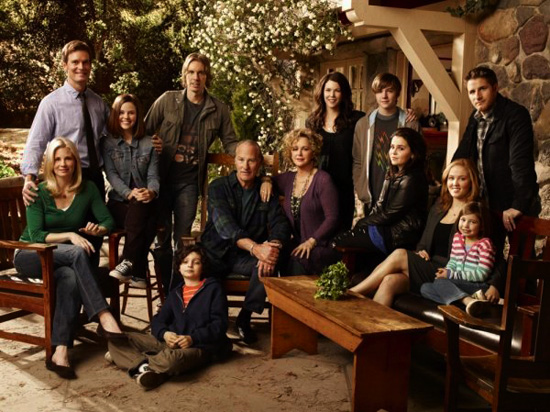
During the Winter Olympics of 2010, the heavily promoted plugs for Parenthood were debuted. Parenthood, an hour long series aired on NBC on March 2nd at 10 pm (PST). This new multi- generational drama series takes over the timeslot of Jay Leno on NBC and is produced and created by entertainment heavyweights Ron Howard, Brian Grazer and Jason Katims. The television series is a “rip-off” of Ron Howards 1989 feature film similarly titled which starred Steve Martin. Simon During defines a rip off as marketing efforts which are made to entice audiences to consume low- quality work or in this case, concepts that are not original. Parenthood may not be an original storyline, however how it addresses the current exigencies of what the nuclear family struggles with today are what makes the show worth analyzing.
The balancing act of raising a white upper-middle class American family in a Berkley suburb that spans across three generations is the main setting for Parenthood. The storyline revolves mostly on the four middle-aged children of Zeek( Craig T. Nelson) , the opinionated patriarch of the Braverman clan. His son Adam ( Peter Krause) and his wife Kristina (Monica Potter) initially portray a perfect family until the couple struggles with the discovery that their son, Max (Max Burkholder) has a mild variation of autism called aspergers syndrome. With the recent fixation of autism in current society, this conflict addresses an issue through pop culture that is significant in present times. Adam’s sister Sarah( Lauren Graham) portrays the single mom that encounters financial difficulties and is forced to move back in to her parents’ home, together with what she describes in the show as her two “degenerate” teenage children, a son who runs away and a pot smoking daughter. With the current economic slump of the economy in America, Sarah’s conflicts provide single moms dealing with teenage angst a character they can identify within the show. Then there is Julia (Erika Christensen), the hardworking, cell phone dependent lawyer in the family that is overcome with guilt after realizing her daughter prefers her stay at home father over her. Lastly, there is Crosby( Dan Shepard) , the commitment fearing character that provides comic relief. Crosby is forced into promising his current girlfriend a child in three years all the while discovering he is a father to a child of an ex-girlfriend. This first episode is jam packed with trying to establish all the characters with their specific value laden dilemmas and relies heavily on “the narrative, as a frame upon experience, which functions as an argument to view and understand the world in a particular way” (Foss). Parenthood provides a glimpse into the American family culture in 2010 through the exigencies that the characters face.
It is significant to analyze this artifact because of the following three components. First, The television medium in which it is viewed has an audience share of several million and stages the way in which an audience can perceive the realities of their family life. According to the Nielson reports, the premiere episode pulled in a “modest” 8.1 million viewers on March 2nd. Second, The conflicts tackled in Parenthood provide a historic glimpse of the issues that permeate the family structure in the 21st century. And lastly, Parenthoods uniqueness is derived from the how an hour long television series is able to consubstantialize audiences through their narrative.
In this essay, I analyze the pilot episode of Parenthood using a narrative criticism to investigate how the complexities of American family structure is depicted in the year 2010. This critical analysis focuses on the specific narrative elements of the events, characters and audiences of Parenthood and how the rhetorical functions embedded within the narrative of the television show induces the general public to perceive family life. The narrative strategies within the one-hour series of Parenthood convey the message to the audience that family life contains many exigencies that make a family more united.
CHARACTERS, CONFLICTS & EVENTS
The character of Adam portrays the golden boy of the siblings. Zeek tries to enforce the kind of tough love that he used in raising Adam on Max yet Adam takes a different approach with his son. In order to get Max to participate in a baseball game that he coaches, Adam bribes his son by promising a triple scoop of ice-cream and even gets into an altercation with the umpire when Max is called out. In a scene where Kristina reveals to Adam that their son may not just need a tutor to get over school difficulties, Adam struggles with accepting that he will never have the kind of relationship he has hoped for with Max. The transformation in his character from a pushy father wanting his child to excel in sports to becoming a sensitive and accepting father upon learning of his child’s condition makes for a very well rounded character. His character signifies the pillar of strength that becomes vulnerable upon the revelation that his son has aspergers.
The character of Sarah portrays the middle aged daughter that needs to move back to her parents house because of financial difficulties as a single parent. Her two troubled teenagers that have behavioral problems that indicate is a cause of the effect of the divorce of their parents. Sarah’s son Drew runs away back to his Father in Fresno after seeing his mother in an intimate moment with Sarah’s highschool ex-boyfriend. Sarah picks him up that same evening because he is turned away by his druggie father and in a heart touching moment between mother and son, Sarah reiterates to Drew that he deserves a good father and that he always has her to depend on in hopes that she will be enough. Sarah’s character signifies the strength that a mother endures for their children in the midst of trying financial times.
Julias character portrays the switched gender role in where the woman is the one pursuing a career instead of the man in a relationship. She is a lawyer that is good at what she does and makes no excuses for her professional attainments despite her lack of presence in her daughter’s life. Her conflict arises when her five year old daughter overtly prefers her husband over her in two specific sequences. At a family gathering over the dinner table, Julia tries to cut her daughters meat on her plate and her daughter insists in front of everyone that her daddy do it instead. Another scene is when Julia rushes home to tuck her daughter into bed and tries singing her a lullaby but is asked if her daddy can put her to sleep instead. Her analytical reasoning is made evident in a scene when all the four siblings get together and she discloses that her daughter does not like her. Julia’s character signifies the plight of hardworking women that also have children that they need to attend to and the dilemmas that a mother encounters because of their professional careers.
Crosby’s character is the commitment fearing single male of the bunch. After finding a canister of frozen sperm in his on again off again girlfriends’ freezer, He is forced to appease his partner who feels her biological clock ticking. With or without him, she is going to have a baby and just spent a large sum of money purchasing sperm from an Olympic athlete. In one of the funniest lines of the episode, Crosby “googles her sperm” and finds out that the sperm is actually not as top quality as his girlfriend made it seem. The twist for Crosby’s character happens towards the end when he find out that he has a child with his ex girlfriend who he hasn’t heard of in five years. By including Crosby’s character for comic relief, audiences who actually don’t have a family are able to relate to the show amidst the drama of the other characters.
All these characters serve a representation of how one is able to surpass their exigencies. All the current the topics that people are grappling with today in society are squeezed into an hour of television airtime . Special needs children, financial woes, troubled teenagers, reversed gender roles and commitment phobic men are all presented in the lives of one multi-generational family through the use of the narrative elements such as character, plot lines and themes. The current themes that are interwoven within the narrative persuades the audience that family life is tough and challenging. More so than just being a parent, the show reiterates the responsibilities that come with being a parent and how despite the trials, it is the family that will stand by you in the end.
Parenthood on NBC, through the use of it’s character’s, their themes and events, create a clear depiction of the American family life in the year 2010.As seen with the four lead characters, each family has their own set of problems that they deal with that tackle issues of contemporary society. Adam in the final scenes of the episode seeks help from his father when he opens up with tears brimming in his eyes and says “there’s something wrong with my son”. In this kernel, Adam’s willingness to share his problems with his father,is a concise indication that he accepts his fate that Max has aspergers and seeks support from his overbearing father, Zeek. In the last scene, the entire Braverman clan is complete around the table in the backyard having lunch al fresco. Max excitedly runs out, asks everyone why he isn’t at the baseball game that day, and reaffirms his importance to his team. There is a moment of hesitation seen on Adams face as he ponders how to react to the situation knowing very well that he will not continue to bribe his child to play sports because of his condition. The moment is suspended as close-ups of the characters have an uncomfortable look on their face. Within a split second, the entire family is up on their feet scrambling to get to the game to all root for Max. The show ends on a close up of Adam’s face as Max hits a homerun. The look on Adam’s face is full of pride, emotion and hope that his family is going to be all right.
In conclusion, the message of Parenthood is simple and straightforward: No matter what the ups and downs one encounters in their daily existence, in the end it is your family that will stand by you, support you and back you up. Parenthood, given the findings of this narrative analysis should be renamed “The Quintessential Family of 2010” instead since it showcases the joys, hardships and humor that a family encounters and how despite these obstacles they embody the structure of strength because they are able to rely on each other when the going gets tough.
The analysis of Parenthood proposes the ways in which television uses particular strategies to create a worldview that seems natural: the American family band together in times of peril. Television stages the world for an audience as the themes and issues that are used within the narrative becomes the way we think our life should be. By deconstructing the narrative elements within Parenthood, we are able to identify with certain characters, their specific individual exigencies and the ways in which they surpass their predicament. This creates a rhetorical artifact that makes for great television because is hard to resist not following their stories. Despite its title, which can make a non-viewer assume it is only a television show about parenting; it is really the family demographic that will be tuned in every week. The narrative of Parenthood explores the current relevant topics of society which explicitly suggests that the American family is a solid and withstanding entity.
Tuesday, January 19, 2010
Ian Mc Ewan's Atonement Critique
ATONEMENT CRITIQUE
In Atonement , one among the many themes that the author, Ian McEwan is implying are the dangers of the power of the imagination and its potential harm when unleashed into the social world. This is the theme that I intend to focus on in this paper. The story is narrated by the protagonist, Briony Tallis ( which we do not uncover till the end) and the destructive implications of her perceptions that she conjures in her mind of the scenarios that she witness’s on a hot summer day in 1935 between her sister Cecilia and the charladys’ son, Robbie Turner. Being that she is only thirteen at the time and not quite exposed to adult intentions and affairs, she implicates Robbie for the crime of sexually molesting her cousin, Lola. This is the elemental reason that transforms all the character’s lives into a downward spiral of guilt, longing, sorrow and hope.
The novel is broken down into three brilliant and vividly written parts, with a concluding chapter simply entitled “London 1999.” Part One is the introduction of the characters and the scenarios that Briony winesses to help setup her claim that she indeed sees Robbie with her own two eyes attack Lola. “The point of view, which is extremely crucial in a story that so dramatically foregrounds perception, is shared by four characters in Part One, set in the Tallis family’s country house in Surrey…”( Hidalgo). Part One ends with Grace Turner, Robbie’s mother, calling out “Liars! Liars!” (McEwan 175) while beating the policecar with her umbrella as they take his son away to prison. Part Two is Robbie’s vivid account of World War II in Northern France and his extreme hardships to reach Dunkirk. It closes with him going to sleep with the hope of going back to London in the morning and him recalling Cecilia’s last words: “I’ll wait for you.Come back.” , before he was hauled away at the end of Part one(249-250). Part Three is now five years later and is Briony’s account of her time spent serving as a nightingale nurse probationer and her brushes with the fatalities of the men at war returning home from Dunkirk. The end of Part Three is Briony leaving Robbie and Cecilia at the Balham tube station after she reaches out to them to try and correct the irrepareable wrongdoings of her false accusations. The novel finally ends in “London, 1999” from a first person narrative where Briony is now about to turn seventy-seven years old and has been diagnosed with vascular Dimentia, which leads her to complete her novel “Atonement”, in her attempt to make up for her crime. These parts are relevant because as the reader, we only discover that it is indeed Briony that has been narrating all along. It is important that the reader makes the connection that McEwan’s Atonement is a novel within a novel, where the main character, Briony Tallis is also a writer.
I shall examine McEwans’ main protagonist, Briony Tallis and her vivid imagination, as well as analyze her characterization, objectives and conflicts within the realm of the novel. McEwan aptly describes Briony as “…one of those children possessed by a desire to have the world just so” (4). The novel deals with many themes such as guilt, crime and punishment which Briony struggles with after her misconstrued perception of reality that leads her to “lie”. However, because she is still technically just a child, is it understandable that she arrived at such a disastrous notion and further, even forgivable that she commits this crime?
According to Christopher Ringrose, “The telling of lies is significant in fiction written for children, and is often (though not in all cases) performed by child protagonists”. Let us therefore bring forth the epistemological question of many philosophers, what is truth? This writer claims that there are three levels of “lying” in children’s literature and since our protagonist is that of a budding writer, it is apt to consider these levels. The first one I mentioned is the level where the fabric of morality is questioned. The second level, which Briony’s category most likely falls under: “...lying as a social act: a crime, a sin, for revenge or for the sake of malevolence.” And yet, she clearly condemns Robbie because of the tumultuous events that led up to Lola’s attack. She truly believes in her young heart and undeveloped mind that she is protecting her sister from the maniac that she saw earlier that afternoon by the fountain in a confrontation with her sister, and so in a defiant kind of way, Briony wrongly accuses Robbie out of her love for Cecilia. The third level of lying is solely for artistic purposes: “…but in terms of the intoxicating creativity of lying—falsehoods identified as acts of imaginative power…” which could very well be Briony’s excuse. The scene in the library when Briony witnesses Robbie and Cecilia making love but does not at the time comprehend this and instead thinks Robbie is attacking Cecilia is a crucial event that leads to her unwavering conviction. “Though they were immobile, her immediate understanding was that she had interrupted an attack, a hand to hand fight. The scene was so entirely a realization of her worst fears that she sensed that her overanxious imagination had projected the figures onto the packed spines of books” (McEwan 116).This theme of storytelling and imagination seemingly intertwined with the morality of a girl on the verge of puberty is what makes McEwan’s Atonement a brilliant page turner; a saga with a well staged plot.
Time (magazine) named Atonement the best fiction novel of the year in 2005 and included it in its All-TIME 100 Greatest Novels. One of the critics of the magazine, Richard Lacayo says on their website:
But McEwan is crafty. Even as he shows us the deadly force of storytelling, he demonstrates its beguilements on every page. Then he leads us to a surprise ending in which the power of fiction, which has been used to undo lives, is used again to make heartbroken amends.
That surprise ending that Lacayo speaks of are two things. One—the narrator was Briony, the protagonist all along which we only discover at the end of Part Three as mentioned earlier, and secondly, through Briony’s talents as a novelist, she pens a version where the lovers actually do unite. “It is only in this last version that my lovers end well. Standing side by side on a South London pavement as I walk away” (McEwan 350). When in fact, Robbie never makes it back from Dunkirk and “…died of septicemia at Bray Dunes on 1 June 1940, or that Cecilia was killed in September of the same year by the bomb that destroyed Balham Underground station” (350).
However the novelist, art historian and critic, Anita Brookner does not agree with our earlier critic, Richard Lakayo. In the online U.K magazine, The Spectator, she writes :
Whether Briony’s conscience can ever be clear, and, more important, whether McEwan’s purpose can be adequately served by such a device, is open to question. That these are troubling matters is certainly well established. The ending, however, is too lenient. (…) Here his suave attempts to establish morbid feelings as inspiration for a life’s work -- and for that work to be crowned with success -- are unconvincing.
About changing the fates of Robbie and Cecilia in her final version of the book, Briony says “Who would want to believe that the young lovers never met again, never fulfilled their love? Who would want to believe that, except in the service of the bleakest realism?” (McEwan 350). Atonement has two endings---one in which the fantasy of the lovers are fulfilled, and one in which the fantasy is stripped away. The emotional effect of this double ending is perhaps what the critic Brookner is unconvinced about. She perhaps does not think that McEwan is successful in having his protagonist absolved of her sin by her attempt at “atonement” through her work of fiction. She justifies her creativity as a means for her atonement in the lines: “In her imagination she has set the limits and the terms. No atonement for God, or novelists, even if they are atheists. It was always an impossible task, and that was precisely the point. The attempt was all” (351). How is atonement at all possible if there is no superior being that can cleanse one of their sins? Briony claims that this is a concept that is unreachable. Although she hints that it is not how it ends but the effort it took to achieve the purpose, the painstaking recalling of events and endless rewrites and drafts before materializing the final copy. “By analogy one could argue that even if the truth of the self simply cannot be reached in confession, what matters is the attempt, the performative process of confessing, which generates and reveals a true story” (Elke).
Is Briony right in thinking that “…it isn’t weakness or evasion, but a final act of kindness, a stand against oblivion and despair, to let my lovers live and to unite them in the end.” (McEwan 351). Is Briony’s novel effective, in her own conscience as an act of atonement and does the completed novel implore the reader to forgive her crime of condemnation towards Robbie?
Ian McEwan, the author of this masterpiece says, “Part of the intention of Atonement was to look at storytelling itself. And to examine the relationship between what is imagined and what is true” ( qtd. in Reynolds and Noakes 19). He was able to capture storytelling in it’s highest form through his characterization of Briony. She is an excellent example of how art has shaped her thoughts, her mind and her impulsive actions. From the beginning of the first chapter, her powerful imagination works to interchange the real from the fantasy. She says herself, “…the imagination itself was a souce of secrets” (McEwan 6).Upon reading Robbie’s shocking letter to Cecilia, she is mortified at the four letter word with which she has yet to fully have a handle on and yet this letter was never intended for her eyes and subsequently transforms her into the world of adult notions—“No more princesses!…With the letter, something elemental, brutal, perhaps even criminal had been introduced, some principle of darkness…she did not doubt that her sister was in some way threatened and would need her help” ( 106-107).
McEwan wittingly builds Briony’s imagination woven with a web of fear which catapults her reprehensable crime. He has been praised by The Oregonian : “Thorougly convincing… Memorable…The book’s battle scenes are some of the most vivid and disturbing in recent history” (McEwan prologue). He has been commended on many occasions for his gifted ability to write about World War II and he has stated in many interviews that war had such a constant presence in his childhood. Having been born in 1948, his father was a soldier and so he attributes how the war has shaped his family life and even reveals how this time brought his mother and father together. He spent his early childhood on British military bases in England then in Singapore and Libya. It was in the 1970’s when his career as a writer took off and to date has written ten novels, two stories, two children’s fiction books, three screenplays and two liberato for oratorio’s. He has won over ten awards and prizes for his various works and not too recently found himself in a plagiarizing scandal with the deceased writer, Lucinda Andrews, whom he clearly acknowledges at the end of his novel. He defends himself wtith a statement published on November 27,2006 in the UK newspaper The Guardian:
No Time for Romance, the autobiography of Lucilla Andrews, a well-known writer of hospital romances - my mother used to read her novels with great pleasure. Contained within this book was a factual account of the rigors of Nightingale training, the daily routines and crucially, of the arrival of wounded soldiers from the Dunkirk evacuation and their treatment. As far as I know, no other such factual account exists. Andrews even recounted an episode that paralleled my father's experience of being told off for swearing.
He addresses this shameful accusation of a Sunday newspaper that claims he has copied the work of Ms. Andrews by a graceful one liner: “An inspiration, yes. Did I copy from another author? No.”
Atonement is a masterpiece and I enjoyed McEwan’s destructive yet very romantic themes of crime, guilt, love and regret, within the context of fiction. However, can atonement be rendered to McEwan’s heroine even though the harm that Briony has caused has already been unleashed into the “real” world and she herself confesses that no amount of poetic expression on her part can bring back the time stolen from the lovers, Robbie and Cecilia? Briony’s characterization and her inner conflict of sorrow and regret are projected with such powerful complexity. These themes that McEwan explores so vividly made me realize how easy it is for anyone of us, child or not to commit this same crime (on a much smaller scale of course). Judgment plays a factor in our lives as human beings every single day. We are constantly sizing each other up and are easily swayed by hear say and gossip, that even sometimes, like Briony, our minds and our perceptions play tricks on us. Sadly, we believe what we want to believe and sometimes we do not see the simplistic facts before us because we are too caught up trying to break down a situation to find hidden meanings when all along the messages are straightforward and precise. Besides, there is a saying that I always thought was amusing and comical. It goes: “Who are we to judge, when we are not a judge?”
In this case, the cinematic version starring Keirra Knightly paled in comparison to McEwan’s novel. I had watched the film prior to reading Atonement and thought it was indeed a beautiful story. But upon completing the novel, I found myself wanting to reread certain elements that got lost within the film. A particularly important element was how the ending of the novel is marked by Briony’s return to Surrey on her seventy-seventh birthday. The play she had written that long hot summer back in 1935, The Trials of Arabella is being staged for the very first time by the younger generation of her family as a birthday presentation to her. It takes place in the library where she had witnessed Robbie and Cecilia in their moment of passion,. The film version ends on an entirely different feel, where she is being interviewed for a television broadcast and is far less touching and gripping than McEwan’s element of loving familial respect and support.
If I can forgive Briony or not, for the disastrous consequences of her vivid and creative imagination is not the point. “It is this kind of imagination that Briony spends the rest of her professional life seeking to acquire. The novel we read and that took her adult lifetime to write is her attempt to project herself into the feelings of the two characters whose lives her failure of imagination destroyed” (Finney). My favorite lines in Atonement is spoken by Briony, which the thesis is about, as she says, “The attempt was all” and that her atonement “was always an impossible act, and that was precisely the point” (351).
McEwan states that Briony was the most completed person he’d ever conjured, and he’d like to do that again and take it further. (qtd. in Reynolds and Noakes 23). I have developed a fascination for Briony Tallis’s mutlifaceted characterization and I am anticipating to see what kind of fictional person can top her off. I really can’t wait to read what McEwan comes up with next, as I am sure it will be a masterpiece just like Atonement that I can enjoy time and time again.
In Atonement , one among the many themes that the author, Ian McEwan is implying are the dangers of the power of the imagination and its potential harm when unleashed into the social world. This is the theme that I intend to focus on in this paper. The story is narrated by the protagonist, Briony Tallis ( which we do not uncover till the end) and the destructive implications of her perceptions that she conjures in her mind of the scenarios that she witness’s on a hot summer day in 1935 between her sister Cecilia and the charladys’ son, Robbie Turner. Being that she is only thirteen at the time and not quite exposed to adult intentions and affairs, she implicates Robbie for the crime of sexually molesting her cousin, Lola. This is the elemental reason that transforms all the character’s lives into a downward spiral of guilt, longing, sorrow and hope.
The novel is broken down into three brilliant and vividly written parts, with a concluding chapter simply entitled “London 1999.” Part One is the introduction of the characters and the scenarios that Briony winesses to help setup her claim that she indeed sees Robbie with her own two eyes attack Lola. “The point of view, which is extremely crucial in a story that so dramatically foregrounds perception, is shared by four characters in Part One, set in the Tallis family’s country house in Surrey…”( Hidalgo). Part One ends with Grace Turner, Robbie’s mother, calling out “Liars! Liars!” (McEwan 175) while beating the policecar with her umbrella as they take his son away to prison. Part Two is Robbie’s vivid account of World War II in Northern France and his extreme hardships to reach Dunkirk. It closes with him going to sleep with the hope of going back to London in the morning and him recalling Cecilia’s last words: “I’ll wait for you.Come back.” , before he was hauled away at the end of Part one(249-250). Part Three is now five years later and is Briony’s account of her time spent serving as a nightingale nurse probationer and her brushes with the fatalities of the men at war returning home from Dunkirk. The end of Part Three is Briony leaving Robbie and Cecilia at the Balham tube station after she reaches out to them to try and correct the irrepareable wrongdoings of her false accusations. The novel finally ends in “London, 1999” from a first person narrative where Briony is now about to turn seventy-seven years old and has been diagnosed with vascular Dimentia, which leads her to complete her novel “Atonement”, in her attempt to make up for her crime. These parts are relevant because as the reader, we only discover that it is indeed Briony that has been narrating all along. It is important that the reader makes the connection that McEwan’s Atonement is a novel within a novel, where the main character, Briony Tallis is also a writer.
I shall examine McEwans’ main protagonist, Briony Tallis and her vivid imagination, as well as analyze her characterization, objectives and conflicts within the realm of the novel. McEwan aptly describes Briony as “…one of those children possessed by a desire to have the world just so” (4). The novel deals with many themes such as guilt, crime and punishment which Briony struggles with after her misconstrued perception of reality that leads her to “lie”. However, because she is still technically just a child, is it understandable that she arrived at such a disastrous notion and further, even forgivable that she commits this crime?
According to Christopher Ringrose, “The telling of lies is significant in fiction written for children, and is often (though not in all cases) performed by child protagonists”. Let us therefore bring forth the epistemological question of many philosophers, what is truth? This writer claims that there are three levels of “lying” in children’s literature and since our protagonist is that of a budding writer, it is apt to consider these levels. The first one I mentioned is the level where the fabric of morality is questioned. The second level, which Briony’s category most likely falls under: “...lying as a social act: a crime, a sin, for revenge or for the sake of malevolence.” And yet, she clearly condemns Robbie because of the tumultuous events that led up to Lola’s attack. She truly believes in her young heart and undeveloped mind that she is protecting her sister from the maniac that she saw earlier that afternoon by the fountain in a confrontation with her sister, and so in a defiant kind of way, Briony wrongly accuses Robbie out of her love for Cecilia. The third level of lying is solely for artistic purposes: “…but in terms of the intoxicating creativity of lying—falsehoods identified as acts of imaginative power…” which could very well be Briony’s excuse. The scene in the library when Briony witnesses Robbie and Cecilia making love but does not at the time comprehend this and instead thinks Robbie is attacking Cecilia is a crucial event that leads to her unwavering conviction. “Though they were immobile, her immediate understanding was that she had interrupted an attack, a hand to hand fight. The scene was so entirely a realization of her worst fears that she sensed that her overanxious imagination had projected the figures onto the packed spines of books” (McEwan 116).This theme of storytelling and imagination seemingly intertwined with the morality of a girl on the verge of puberty is what makes McEwan’s Atonement a brilliant page turner; a saga with a well staged plot.
Time (magazine) named Atonement the best fiction novel of the year in 2005 and included it in its All-TIME 100 Greatest Novels. One of the critics of the magazine, Richard Lacayo says on their website:
But McEwan is crafty. Even as he shows us the deadly force of storytelling, he demonstrates its beguilements on every page. Then he leads us to a surprise ending in which the power of fiction, which has been used to undo lives, is used again to make heartbroken amends.
That surprise ending that Lacayo speaks of are two things. One—the narrator was Briony, the protagonist all along which we only discover at the end of Part Three as mentioned earlier, and secondly, through Briony’s talents as a novelist, she pens a version where the lovers actually do unite. “It is only in this last version that my lovers end well. Standing side by side on a South London pavement as I walk away” (McEwan 350). When in fact, Robbie never makes it back from Dunkirk and “…died of septicemia at Bray Dunes on 1 June 1940, or that Cecilia was killed in September of the same year by the bomb that destroyed Balham Underground station” (350).
However the novelist, art historian and critic, Anita Brookner does not agree with our earlier critic, Richard Lakayo. In the online U.K magazine, The Spectator, she writes :
Whether Briony’s conscience can ever be clear, and, more important, whether McEwan’s purpose can be adequately served by such a device, is open to question. That these are troubling matters is certainly well established. The ending, however, is too lenient. (…) Here his suave attempts to establish morbid feelings as inspiration for a life’s work -- and for that work to be crowned with success -- are unconvincing.
About changing the fates of Robbie and Cecilia in her final version of the book, Briony says “Who would want to believe that the young lovers never met again, never fulfilled their love? Who would want to believe that, except in the service of the bleakest realism?” (McEwan 350). Atonement has two endings---one in which the fantasy of the lovers are fulfilled, and one in which the fantasy is stripped away. The emotional effect of this double ending is perhaps what the critic Brookner is unconvinced about. She perhaps does not think that McEwan is successful in having his protagonist absolved of her sin by her attempt at “atonement” through her work of fiction. She justifies her creativity as a means for her atonement in the lines: “In her imagination she has set the limits and the terms. No atonement for God, or novelists, even if they are atheists. It was always an impossible task, and that was precisely the point. The attempt was all” (351). How is atonement at all possible if there is no superior being that can cleanse one of their sins? Briony claims that this is a concept that is unreachable. Although she hints that it is not how it ends but the effort it took to achieve the purpose, the painstaking recalling of events and endless rewrites and drafts before materializing the final copy. “By analogy one could argue that even if the truth of the self simply cannot be reached in confession, what matters is the attempt, the performative process of confessing, which generates and reveals a true story” (Elke).
Is Briony right in thinking that “…it isn’t weakness or evasion, but a final act of kindness, a stand against oblivion and despair, to let my lovers live and to unite them in the end.” (McEwan 351). Is Briony’s novel effective, in her own conscience as an act of atonement and does the completed novel implore the reader to forgive her crime of condemnation towards Robbie?
Ian McEwan, the author of this masterpiece says, “Part of the intention of Atonement was to look at storytelling itself. And to examine the relationship between what is imagined and what is true” ( qtd. in Reynolds and Noakes 19). He was able to capture storytelling in it’s highest form through his characterization of Briony. She is an excellent example of how art has shaped her thoughts, her mind and her impulsive actions. From the beginning of the first chapter, her powerful imagination works to interchange the real from the fantasy. She says herself, “…the imagination itself was a souce of secrets” (McEwan 6).Upon reading Robbie’s shocking letter to Cecilia, she is mortified at the four letter word with which she has yet to fully have a handle on and yet this letter was never intended for her eyes and subsequently transforms her into the world of adult notions—“No more princesses!…With the letter, something elemental, brutal, perhaps even criminal had been introduced, some principle of darkness…she did not doubt that her sister was in some way threatened and would need her help” ( 106-107).
McEwan wittingly builds Briony’s imagination woven with a web of fear which catapults her reprehensable crime. He has been praised by The Oregonian : “Thorougly convincing… Memorable…The book’s battle scenes are some of the most vivid and disturbing in recent history” (McEwan prologue). He has been commended on many occasions for his gifted ability to write about World War II and he has stated in many interviews that war had such a constant presence in his childhood. Having been born in 1948, his father was a soldier and so he attributes how the war has shaped his family life and even reveals how this time brought his mother and father together. He spent his early childhood on British military bases in England then in Singapore and Libya. It was in the 1970’s when his career as a writer took off and to date has written ten novels, two stories, two children’s fiction books, three screenplays and two liberato for oratorio’s. He has won over ten awards and prizes for his various works and not too recently found himself in a plagiarizing scandal with the deceased writer, Lucinda Andrews, whom he clearly acknowledges at the end of his novel. He defends himself wtith a statement published on November 27,2006 in the UK newspaper The Guardian:
No Time for Romance, the autobiography of Lucilla Andrews, a well-known writer of hospital romances - my mother used to read her novels with great pleasure. Contained within this book was a factual account of the rigors of Nightingale training, the daily routines and crucially, of the arrival of wounded soldiers from the Dunkirk evacuation and their treatment. As far as I know, no other such factual account exists. Andrews even recounted an episode that paralleled my father's experience of being told off for swearing.
He addresses this shameful accusation of a Sunday newspaper that claims he has copied the work of Ms. Andrews by a graceful one liner: “An inspiration, yes. Did I copy from another author? No.”
Atonement is a masterpiece and I enjoyed McEwan’s destructive yet very romantic themes of crime, guilt, love and regret, within the context of fiction. However, can atonement be rendered to McEwan’s heroine even though the harm that Briony has caused has already been unleashed into the “real” world and she herself confesses that no amount of poetic expression on her part can bring back the time stolen from the lovers, Robbie and Cecilia? Briony’s characterization and her inner conflict of sorrow and regret are projected with such powerful complexity. These themes that McEwan explores so vividly made me realize how easy it is for anyone of us, child or not to commit this same crime (on a much smaller scale of course). Judgment plays a factor in our lives as human beings every single day. We are constantly sizing each other up and are easily swayed by hear say and gossip, that even sometimes, like Briony, our minds and our perceptions play tricks on us. Sadly, we believe what we want to believe and sometimes we do not see the simplistic facts before us because we are too caught up trying to break down a situation to find hidden meanings when all along the messages are straightforward and precise. Besides, there is a saying that I always thought was amusing and comical. It goes: “Who are we to judge, when we are not a judge?”
In this case, the cinematic version starring Keirra Knightly paled in comparison to McEwan’s novel. I had watched the film prior to reading Atonement and thought it was indeed a beautiful story. But upon completing the novel, I found myself wanting to reread certain elements that got lost within the film. A particularly important element was how the ending of the novel is marked by Briony’s return to Surrey on her seventy-seventh birthday. The play she had written that long hot summer back in 1935, The Trials of Arabella is being staged for the very first time by the younger generation of her family as a birthday presentation to her. It takes place in the library where she had witnessed Robbie and Cecilia in their moment of passion,. The film version ends on an entirely different feel, where she is being interviewed for a television broadcast and is far less touching and gripping than McEwan’s element of loving familial respect and support.
If I can forgive Briony or not, for the disastrous consequences of her vivid and creative imagination is not the point. “It is this kind of imagination that Briony spends the rest of her professional life seeking to acquire. The novel we read and that took her adult lifetime to write is her attempt to project herself into the feelings of the two characters whose lives her failure of imagination destroyed” (Finney). My favorite lines in Atonement is spoken by Briony, which the thesis is about, as she says, “The attempt was all” and that her atonement “was always an impossible act, and that was precisely the point” (351).
McEwan states that Briony was the most completed person he’d ever conjured, and he’d like to do that again and take it further. (qtd. in Reynolds and Noakes 23). I have developed a fascination for Briony Tallis’s mutlifaceted characterization and I am anticipating to see what kind of fictional person can top her off. I really can’t wait to read what McEwan comes up with next, as I am sure it will be a masterpiece just like Atonement that I can enjoy time and time again.
Subscribe to:
Posts (Atom)